Skills-Based Hiring Playbook Using Typing Tests as Proof of Ability
Replace degree requirements with objective typing assessments. This playbook shows business leaders how to implement skills-based hiring with measurable benchmarks and data-driven decisions.
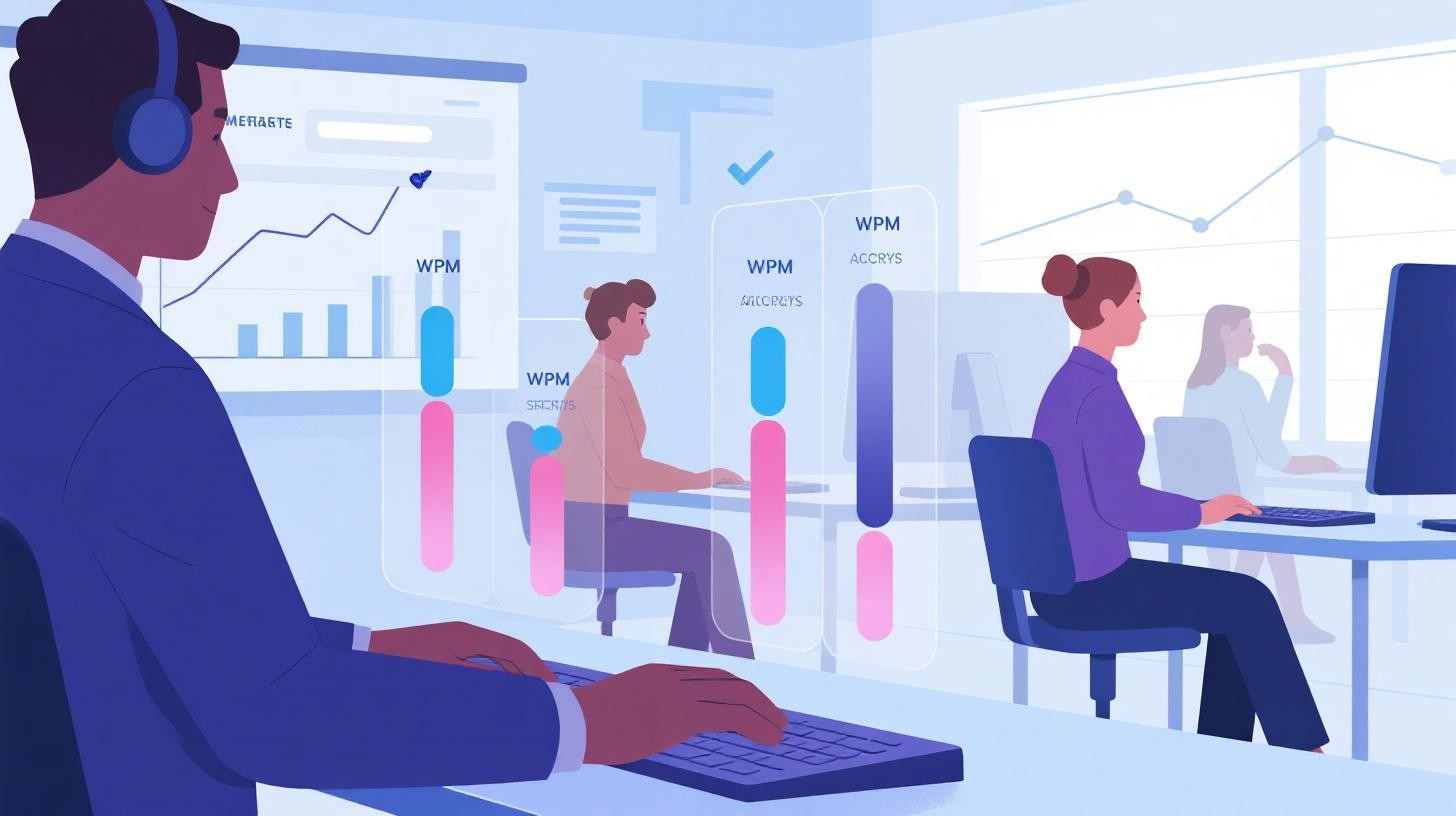
A four-year degree tells you someone can finish a program. It doesn't tell you whether they can type 65 words per minute with 98% accuracy while handling a customer service queue. That distinction matters more than most hiring managers realize, and it's reshaping how forward-thinking companies build their teams.
The shift toward skills-based hiring isn't a passing trend. It's a structural change in how organizations evaluate talent. Across industries, employers are discovering that degree requirements filter out capable candidates without actually predicting job performance. And when it comes to roles that demand keyboard proficiency, there's a remarkably simple way to measure real ability: give candidates a typing test.
This playbook walks you through implementing typing assessments as a core part of a no-degree hiring strategy. You'll learn why degree requirements hurt more than they help, how to build objective evaluation frameworks, and how to use tools like TypeFlow to make the whole process measurable and fair. Whether you're hiring for a single data entry role or scaling a customer support operation, the principles here will help you find better candidates faster.
Why Degree Requirements Are the Wrong Filter for Keyboard-Heavy Roles
Let's start with an uncomfortable truth: requiring a bachelor's degree for a medical transcriptionist, data entry specialist, or administrative assistant role has almost nothing to do with the actual work. These positions demand speed, accuracy, and consistency at a keyboard. No college curriculum guarantees those skills, and plenty of self-taught professionals deliver them at exceptional levels.
The numbers back this up. The U.S. Department of Labor has actively promoted skills-first hiring practices, recognizing that degree-based screening excludes qualified workers and narrows talent pools unnecessarily. When you require a degree for a role that primarily involves typing, data management, or document processing, you're not raising the bar. You're just making it harder for talented people to reach it.
Think about what actually predicts success in a typing-intensive role. It's not where someone went to school. It's whether they can sustain 70 WPM with minimal errors over a five-minute stretch. It's whether their accuracy holds up when they're working from unfamiliar source material. It's whether they can maintain focus and consistency across an eight-hour workday. These are measurable, observable skills, and none of them require a diploma to develop.
The business case goes deeper than fairness. Companies that drop degree requirements for these roles see immediate improvements in several areas. Applicant pools expand dramatically, sometimes by 30% or more. Time-to-hire shrinks because you're evaluating candidates on relevant criteria instead of sorting through transcripts. Quality of hire often improves because you're selecting for demonstrated ability rather than credential proxies.
There's also a retention angle that many leaders overlook. Candidates who are hired based on proven skills tend to feel more confident in their roles from day one. They know they earned their spot through performance, not paperwork. That confidence translates into stronger engagement and lower early-stage turnover, two metrics that directly impact your bottom line.
The practical challenge, of course, is replacing the degree filter with something equally scalable. You can't interview every applicant for 45 minutes to assess their keyboard skills. You need a standardized, efficient way to evaluate large numbers of candidates against objective benchmarks. That's exactly where typing assessments come in, and it's why they've become the cornerstone of skills-first hiring for any role that involves significant keyboard work.
Removing degree requirements without adding skills-based evaluation creates chaos. You'll be flooded with applications and have no systematic way to identify top performers. The key is substitution, not subtraction. You're replacing one filter (credentials) with a better one (demonstrated ability). Typing tests give you that better filter in a format that's fast, fair, and impossible to fake.
Building an Objective Typing Assessment Framework for Your Hiring Pipeline
Implementing typing tests effectively requires more than sending candidates a link and checking their WPM. You need a structured framework that defines what good looks like for each role, standardizes the evaluation process, and produces data you can actually use to make hiring decisions.
Start by establishing role-specific benchmarks. A customer service representative who handles live chat needs different skills than a legal secretary who transcribes depositions. The chat agent might need 50-60 WPM with strong accuracy under time pressure. The legal secretary might need 70-80 WPM with near-perfect accuracy on specialized terminology. Your benchmarks should reflect the real demands of the job, not arbitrary industry averages.
Here's a practical framework for setting benchmarks across common typing-intensive roles:
Role Category | Target WPM | Minimum Accuracy | Test Duration | Key Focus |
Data Entry Clerk | 60-75 WPM | 97% | 5 minutes | Speed + consistency |
Customer Service Rep | 45-60 WPM | 95% | 3 minutes | Speed under pressure |
Medical Transcriptionist | 65-80 WPM | 98% | 5 minutes | Accuracy with terminology |
Legal Secretary | 70-85 WPM | 98% | 5 minutes | Precision + formatting |
Administrative Assistant | 50-65 WPM | 96% | 3 minutes | Balanced speed/accuracy |
Once you've defined your benchmarks, you need a testing platform that matches them. TypeFlow's industry-specific typing test templates cover medical, legal, customer service, data entry, and general typing scenarios. Instead of building tests from scratch, you can select a template that mirrors the actual content your new hire will encounter on the job. A medical transcription test uses clinical terminology. A legal test uses contract language. This specificity matters because typing speed drops significantly when people encounter unfamiliar words.
The next step is integrating tests into your application workflow. The most effective approach is to make the typing assessment an early-stage gate, ideally right after initial application review. This creates a natural funnel:
Application submission with no degree requirement listed
Automated typing test invitation sent to all qualified applicants
Benchmark filtering to identify candidates who meet your WPM and accuracy thresholds
Interview stage focused on soft skills, culture fit, and role-specific questions
Final selection combining test performance data with interview insights
This structure respects candidates' time by filtering early on objective criteria. It also protects your hiring team's time by ensuring that every person who reaches the interview stage has already proven they can do the core technical work.
Security is another critical consideration. When you're using test results as hiring criteria, you need confidence that the results are legitimate. TypeFlow's security monitoring detects tab switches, paste attempts, focus loss, and suspicious typing patterns. If a candidate tries to use auto-typing software or copies text from another source, the system flags it. This gives you the same confidence in remote assessments that you'd have with in-person testing, without requiring candidates to travel to your office.
For organizations hiring at scale, efficiency becomes paramount. TypeFlow supports bulk email invitations through CSV upload or manual entry on Professional and Enterprise plans. If you're filling 50 customer service positions, you can send personalized test links to your entire candidate pool in minutes. Each candidate gets a unique link, and their results flow into a centralized dashboard where you can sort, filter, and compare performance. You can explore the different plan options to find the right fit for your hiring volume.
Turning Test Data Into Smarter, Faster Hiring Decisions
Collecting typing test results is only half the equation. The real value comes from how you analyze and act on that data. Skills-based hiring works best when it's genuinely data-driven, not when you simply swap one gut-feeling filter for another.
The TypeFlow recruiter dashboard gives you a centralized view of test usage stats, candidate counts, pass rates, and performance analytics. But having the data isn't enough. You need to know what to look for and how to interpret it.
Start with pass rate analysis. If your pass rate for a given role is below 20%, your benchmarks might be too aggressive. If it's above 80%, they're probably too lenient to differentiate candidates meaningfully. A healthy pass rate for screening purposes typically falls between 30% and 60%, tight enough to filter effectively but broad enough to maintain a viable candidate pool.
Look beyond the headline WPM number. Accuracy is often more predictive of job success than raw speed. A candidate who types 75 WPM with 92% accuracy will produce more errors per hour than someone typing 60 WPM at 99% accuracy. In roles where mistakes have real consequences, like medical transcription or legal document preparation, accuracy should be weighted more heavily in your evaluation criteria.
Consistency matters too. Some candidates start strong and fade. Others warm up and finish stronger than they started. The keystroke analysis available in TypeFlow's results view lets you see these patterns. A candidate whose speed drops 15 WPM in the final minute of a five-minute test might struggle with sustained focus, something that matters enormously in all-day typing roles.
Here's how to build a scoring rubric that accounts for multiple dimensions:
Speed score (40%): WPM relative to your role-specific benchmark
Accuracy score (35%): Error rate with higher weight for roles requiring precision
Consistency score (15%): Variance in speed and accuracy across the test duration
Integrity score (10%): Clean security report with no flagged violations
This multi-factor approach prevents you from over-indexing on any single metric. A candidate who scores well across all four dimensions is almost certainly a stronger hire than someone who typed fastest but had accuracy issues and a flagged security violation.
The analytics also help you refine your process over time. Track the correlation between test scores and actual job performance for your first several cohorts. You might discover that accuracy above 97% is the single strongest predictor of success in your data entry team, or that consistency scores matter more than raw speed for your transcription roles. These insights let you continuously sharpen your benchmarks.
For hiring managers who need to justify the skills-based approach to leadership, the data tells a compelling story. You can show exactly how many candidates were evaluated, what the performance distribution looked like, and why specific individuals were advanced or filtered out. This level of transparency is something degree-based screening never offered. Nobody could explain precisely why a bachelor's degree from one university was a better predictor than an associate's degree from another, but you can absolutely explain why 72 WPM at 98% accuracy outperforms 55 WPM at 94%.
For deeper benchmarking guidance tailored to specific roles, check out our post on 10 key typing tests for hiring with clear KPH benchmarks. It provides additional context for setting thresholds that match real-world job demands.
Your 30-Day Implementation Roadmap for Skills-First Typing Assessments
Knowing the theory is valuable. Executing it is what changes your hiring outcomes. Here's a concrete, step-by-step roadmap for integrating typing assessments into a no-degree hiring strategy within 30 days.
Week 1: Audit and Define
Pull up every open job description that includes a degree requirement. For each one, ask a simple question: does a degree actually predict performance in this role, or is it a proxy for skills we could measure directly? For any position that involves significant typing, data entry, or document processing, the answer is almost always the latter.
Rewrite those job descriptions. Remove degree requirements and replace them with specific, measurable skill expectations. Instead of "Bachelor's degree required," write "Must demonstrate typing speed of 60+ WPM with 97% accuracy." This single change signals to candidates that you value what they can do, not where they studied.
Week 2: Build Your Testing Infrastructure
Set up your TypeFlow account and configure tests for each role you've identified. Use the industry-specific templates as starting points, then customize duration, pass criteria, and number of allowed attempts based on your benchmarks. Set expiration dates for test links so candidates complete assessments within a reasonable window.
Create a standardized email template for test invitations. Keep it warm and encouraging. Many skilled typists without degrees have experienced rejection based on credentials. Your invitation should make clear that you're interested in their abilities, not their paperwork.
Week 3: Launch and Monitor
Begin sending typing assessments to candidates in your active pipelines. Monitor the results daily during this initial phase. Pay attention to completion rates (are candidates actually taking the test?), pass rates (are your benchmarks calibrated correctly?), and any security flags that might indicate issues with your testing process.
Collect feedback from both candidates and hiring managers. Candidates can tell you whether the test felt relevant and fair. Hiring managers can tell you whether the results are helping them make better decisions.
Week 4: Optimize and Scale
Adjust your benchmarks based on the data from week three. If your best candidates are clustering at a certain WPM range, consider whether your pass threshold should shift. If security violations are common, you might need to adjust your communication about test expectations.
Document your process. Create an internal guide that explains the what, why, and how of your typing assessment program. This document becomes the foundation for scaling the approach across departments and for onboarding new hiring managers into the system.
A checklist to track your progress:
Identify all roles where degree requirements can be replaced with skills assessments
Rewrite job descriptions with measurable typing benchmarks
Set up TypeFlow account and configure role-specific tests
Create candidate communication templates
Launch assessments for active job openings
Review first-week data and calibrate benchmarks
Gather feedback from candidates and hiring managers
Document the process for organizational scaling
The organizations that hire best aren't the ones with the longest list of requirements. They're the ones that measure what actually matters. For typing-intensive roles, that means giving candidates a chance to prove their skills through objective assessment rather than asking them to prove their credentials through paperwork.
Ready to build a hiring process that actually predicts job performance? Sign up for TypeFlow and start creating skills-based typing assessments that help you find the right people, regardless of their educational background. Your best hire might be someone who never finished college but can type circles around every other candidate in the pool.
Recommended Reading
How to Prepare for an Employment Typing Test and Pass
Got an employment typing test coming up? Learn exactly what WPM and accuracy benchmarks employers expect, how to practice effectively, and proven test day strategies to pass with confidence.
How Recruiters Can Detect AI Cheating in Remote Typing Tests
Voice assistants, second screens, and scripted bots are undermining remote typing assessments. Learn how keystroke analysis and behavioral monitoring catch AI-assisted cheating before it corrupts your hiring pipeline.
Copy Paste Detection for Secure Remote Typing Tests
Copy/paste is only one clue. Learn a practical integrity model for remote typing tests using tab switches, focus loss, typing rhythm, and clear thresholds.
10 Key Typing Tests for Hiring With Job Ready KPH
Learn how to set job-ready KPH targets, pick numbers-only vs decimals/operators, and build pass criteria that predicts real data-entry output.