Typing Test Requirements for Government and Civil Service Jobs
Government typing tests vary widely by role and agency. Learn the exact WPM benchmarks, test formats, security requirements, and assessment strategies for civil service hiring.
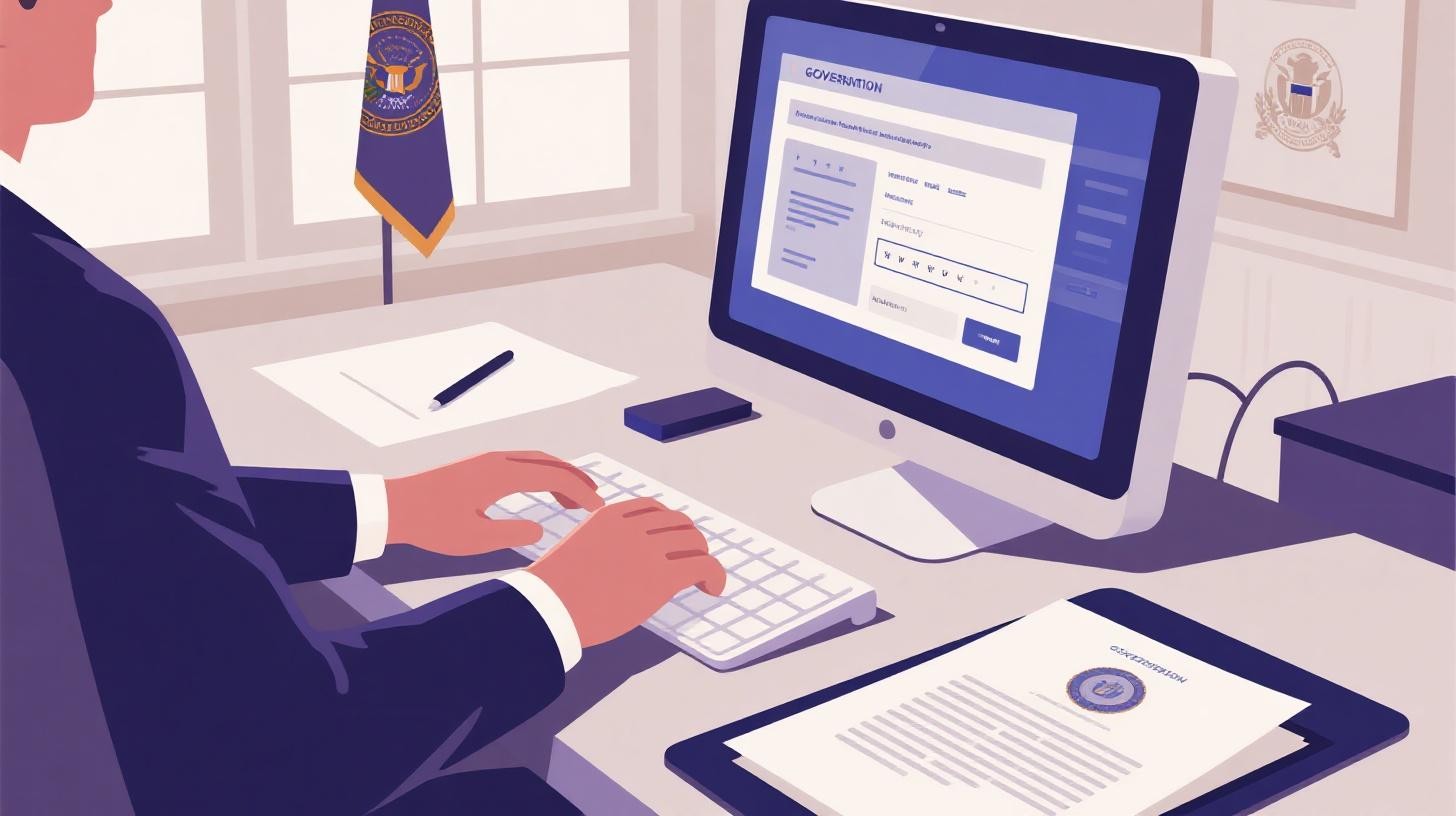
A clerk at a county courthouse processes 200 documents a day. A federal data entry specialist transcribes sensitive records under strict deadlines. A 911 dispatcher types critical information while someone's life hangs in the balance. What do all these roles have in common? They demand fast, accurate typing, and the hiring process needs to verify that candidates can deliver.
Government and civil service agencies have long relied on typing tests as a gatekeeping tool for administrative, clerical, and public safety roles. But the standards vary widely across agencies, job classifications, and levels of government. If you're responsible for hiring in a public sector organization, understanding the specific WPM benchmarks, test formats, and assessment best practices isn't optional. It's the difference between a smooth-running office and a bottleneck that slows down public services.
This guide breaks down what government typing test requirements actually look like, how they compare across roles, and how to build an assessment process that's fair, defensible, and efficient. Whether you're a hiring manager at a municipal office or an HR director for a state agency, you'll walk away with a practical framework you can put to work immediately. And if you're looking for a platform that handles the logistics of typing assessments at scale, TypeFlow's pricing plans offer options built for teams of every size, from small departments to enterprise-level agencies.
WPM Benchmarks Across Government Roles and Classifications
One of the biggest misconceptions about government typing requirements is that there's a single universal standard. There isn't. Typing speed and accuracy requirements vary based on the job classification, the level of government, and the specific duties of the role. Let's look at how these benchmarks actually break down.
For general clerical and administrative assistant positions, most federal, state, and local agencies require a minimum of 40 WPM with at least 90% accuracy. This is the baseline you'll see in job postings from agencies like the Social Security Administration, state departments of motor vehicles, and county clerk offices. According to the Bureau of Labor Statistics, secretaries and administrative assistants remain a significant segment of the workforce, and typing proficiency is listed as a core competency for these roles.
For data entry specialists and records clerks, the bar goes higher. These positions often require 50 to 60 WPM with 95% or higher accuracy. The reason is straightforward: these roles involve high-volume transcription of forms, records, and databases. A 10 WPM difference at this level translates to thousands of additional keystrokes per shift, which compounds into significant productivity differences over weeks and months. If you want to dig deeper into how typing benchmarks correlate with data entry performance, this breakdown of typing test benchmarks offers useful data points.
For court reporters, legal secretaries, and stenographers, requirements jump dramatically. Court reporters may need to sustain 180 to 225 WPM using stenotype machines, though most government typing tests for legal support staff focus on standard keyboard proficiency in the 55 to 70 WPM range with near-perfect accuracy.
Law enforcement dispatchers and emergency communications operators represent another tier. These roles typically require 35 to 45 WPM, but with an emphasis on accuracy under pressure. The typing test for dispatch positions often simulates real-time data entry scenarios where candidates must type while processing auditory information.
Setting the Right Threshold for Your Agency
Here's a practical framework for determining WPM requirements:
Role Category | Minimum WPM | Target Accuracy | Test Duration |
General Clerical / Admin Assistant | 40 WPM | 90%+ | 5 minutes |
Data Entry Specialist | 50-60 WPM | 95%+ | 5-10 minutes |
Legal Secretary / Court Support | 55-70 WPM | 95%+ | 5 minutes |
Emergency Dispatcher | 35-45 WPM | 93%+ | 3-5 minutes |
Executive Secretary | 60-75 WPM | 95%+ | 5 minutes |
The key takeaway here: don't copy another agency's requirements blindly. Audit the actual typing demands of the role. How many documents does the person process daily? How much of their workday involves sustained typing versus other tasks? A receptionist who types occasional notes needs a different benchmark than a transcriptionist who types for six straight hours.
When you set requirements that are too high, you shrink your candidate pool unnecessarily. When you set them too low, you end up with hires who can't keep up with the workload. The sweet spot is a benchmark that reflects the real demands of the position, validated by observing current top performers in the same role.
Test Formats, Security Requirements, and Legal Considerations
Government hiring processes face a level of scrutiny that private sector employers rarely encounter. Civil service exams must be defensible under equal employment opportunity standards, and typing tests are no exception. The format you choose, the conditions under which the test is administered, and the way you handle accommodations all matter enormously.
Common Test Formats in Government Hiring
Most government typing assessments fall into one of three categories:
Timed transcription tests are the most traditional format. Candidates are given a passage of text and asked to type it exactly as shown within a set time limit, usually three to five minutes. The score is calculated as net WPM (gross words typed minus errors, divided by time). This format is straightforward and easy to standardize, which is why it remains popular across state and federal agencies.
Free-form composition tests ask candidates to type a response to a prompt. These are less common in civil service settings because they're harder to score objectively, but some agencies use them for roles that require original correspondence, like constituent services positions.
Simulated work sample tests present candidates with tasks that mirror actual job duties. For a data entry role, this might mean transcribing information from a scanned form into fields. For a dispatcher, it might mean typing notes while listening to an audio recording. These tests have higher predictive validity because they assess typing in a realistic context, not just raw speed.
Security and Integrity Measures
Government agencies can't afford to have candidates game the system. A typing test that can be cheated undermines the entire merit-based hiring process that civil service is built on. This is where test security becomes non-negotiable.
Effective security monitoring should detect:
Tab switching and window changes that suggest a candidate is looking up answers or using auto-typing tools
Paste attempts where candidates try to paste pre-typed text into the test field
Focus loss events where the candidate navigates away from the testing interface
Suspicious typing patterns like unnaturally consistent keystroke intervals that indicate automated input
Platforms like TypeFlow include built-in security monitoring that flags these behaviors automatically, generating violation reports that hiring managers can review alongside performance metrics. This level of transparency is particularly important for government agencies that need to document and defend their hiring decisions.
ADA Compliance and Accommodations
Any government employer administering typing tests must comply with the Americans with Disabilities Act. This means providing reasonable accommodations for candidates with physical or cognitive disabilities that affect typing performance. Common accommodations include extended time, alternative input devices, modified test formats, and adjusted scoring criteria.
The critical point is that your testing platform and process must be flexible enough to implement these accommodations without compromising the validity of the assessment. If you need guidance on building an accommodation-ready testing process, this resource on ADA-compliant typing test accommodations covers the specifics.
Document every accommodation request, the rationale for the accommodation provided, and how scoring was adjusted. This paper trail protects your agency in the event of a legal challenge and demonstrates good faith compliance.
Building a Scalable Assessment Process for Government Hiring
Government hiring doesn't move in trickles. When a state agency posts a clerical position, it might receive hundreds of applications. When a city government hires seasonal workers, it might need to assess dozens of candidates in a single week. Your typing assessment process needs to handle volume without sacrificing quality or fairness.
Step 1: Define the Assessment Criteria Before Posting the Job
Before you even write the job listing, nail down the typing requirements. Work with the hiring manager and current employees to establish:
The minimum WPM threshold (use the benchmarks from the table above as a starting point)
The minimum accuracy percentage
The test duration
Whether you'll use transcription, work sample, or composition format
The number of attempts candidates get
The expiration window for completing the test
When these criteria are defined upfront, you avoid the messy situation where candidates challenge results because the standards feel arbitrary or inconsistent.
Step 2: Choose the Right Delivery Method
Government agencies have historically required in-person, proctored typing tests. While this approach maximizes security, it creates logistical headaches. Candidates have to travel to a testing site, the agency has to staff proctors and reserve rooms, and scheduling conflicts slow down the entire hiring timeline.
Remote, browser-based testing solves most of these problems. Candidates complete the test on their own devices, on their own schedule, within a window you define. Modern platforms compensate for the lack of a physical proctor by using behavioral monitoring, detecting the tab switches, paste attempts, and suspicious patterns mentioned earlier.
The hybrid approach works well for government: use remote testing as a screening step to filter candidates who meet the minimum threshold, then bring finalists in for a shorter, proctored verification test. This dramatically reduces the administrative burden while maintaining the integrity of the process.
Step 3: Send Assessments at Scale
When you're hiring for multiple positions or assessing large candidate pools, manually emailing test links one by one isn't realistic. Bulk invitation tools let you upload a CSV of candidate names and email addresses and send personalized test links to everyone at once. This is especially valuable during seasonal hiring surges, competitive exam cycles, or when multiple departments are hiring simultaneously.
TypeFlow's Professional and Enterprise plans support bulk email invitations with CSV upload, which means an HR team can send assessments to 500 candidates in minutes rather than days. The platform also provides unique shareable links, so you can embed the test in your job posting or applicant tracking system.
Step 4: Evaluate Results with Context, Not Just Numbers
A raw WPM score tells you how fast someone types. It doesn't tell you whether they can sustain that speed over a full shift, whether they make more errors under pressure, or whether their typing patterns suggest genuine proficiency versus a one-time performance spike.
Look beyond the headline number. Effective candidate evaluation should consider:
Net WPM vs. gross WPM: Net WPM accounts for errors and gives a more honest picture of productive typing speed
Accuracy trends: Did accuracy stay consistent throughout the test, or did it drop sharply in the final minutes?
Keystroke analysis: Patterns in backspace usage, pause frequency, and rhythm can reveal whether a candidate is a natural typist or someone who memorized a passage
Violation flags: Any security events should be reviewed in context. A single tab switch might be accidental. Multiple paste attempts are a disqualifying red flag.
The best hiring decisions come from combining quantitative scores with qualitative analysis of how the candidate performed under test conditions.
Why Standardized Typing Assessments Strengthen Civil Service Hiring
Government agencies operate under a merit-based hiring principle. Every candidate should be evaluated against the same objective criteria, and the most qualified person should get the job. Typing tests, when done right, are one of the most defensible tools in a civil service hiring toolkit because they produce measurable, comparable, objective data.
But "when done right" is doing a lot of heavy lifting in that sentence. A poorly designed typing assessment, one with unclear standards, inconsistent administration, no security monitoring, and no accommodation protocol, is worse than no assessment at all. It opens the agency to legal challenges, creates a negative candidate experience, and may not even predict on-the-job performance.
Here's what a well-designed government typing assessment program looks like:
WPM and accuracy requirements are documented and tied to specific job duties
Test format mirrors actual work tasks for the role
Security monitoring detects cheating without creating false positives
ADA accommodations are available and documented
Results include detailed performance metrics, not just pass/fail
The process scales to handle high-volume hiring periods
All candidates for the same role take the same test under the same conditions
When you check every box on that list, you've built a process that's fair to candidates, defensible under scrutiny, and genuinely predictive of job performance.
The public sector deserves the same quality of hiring tools that the private sector uses. If your agency is still relying on outdated, in-person-only typing tests with manual scoring, it's time to modernize. A platform that offers configurable test creation, built-in security, detailed analytics, and scalable delivery can transform your hiring process from a bottleneck into a competitive advantage.
Ready to see what that looks like in practice? Explore TypeFlow's plans to find the right fit for your agency's assessment needs, whether you're a small municipal office or a state-level department hiring across dozens of locations.
Recommended Reading
How to Build Multilingual Typing Tests That Actually Work
Standard English typing tests fall short for bilingual roles. Learn how to set fair WPM benchmarks across languages, handle keyboard layout differences, and keep multilingual assessments legally defensible.
10 Key Typing Tests for Hiring With Clear KPH Benchmarks
Learn when a 10-key numeric-only typing test should require a numpad, how to set realistic KPH and 98%+ accuracy thresholds, and how to interpret results fairly.
Pre Employment Typing Test Validity Under UGESP Workflow
Build a UGESP-ready typing test validation kit: job analysis steps, WPM vs 10-key/KPH decision rules, cut score methods, and audit-ready documentation templates.
Typing Test Retake Policy and Tech Issue Playbook
Disconnects and glitches can derail great candidates. Use this retake policy and tech-issue playbook to handle device problems fairly, reduce drop-off, and limit risk.